Three months out, the straw polls say Grynspan leads — but five "discourage" votes of unknown origin mean the only poll that matters hasn't been counted yet.
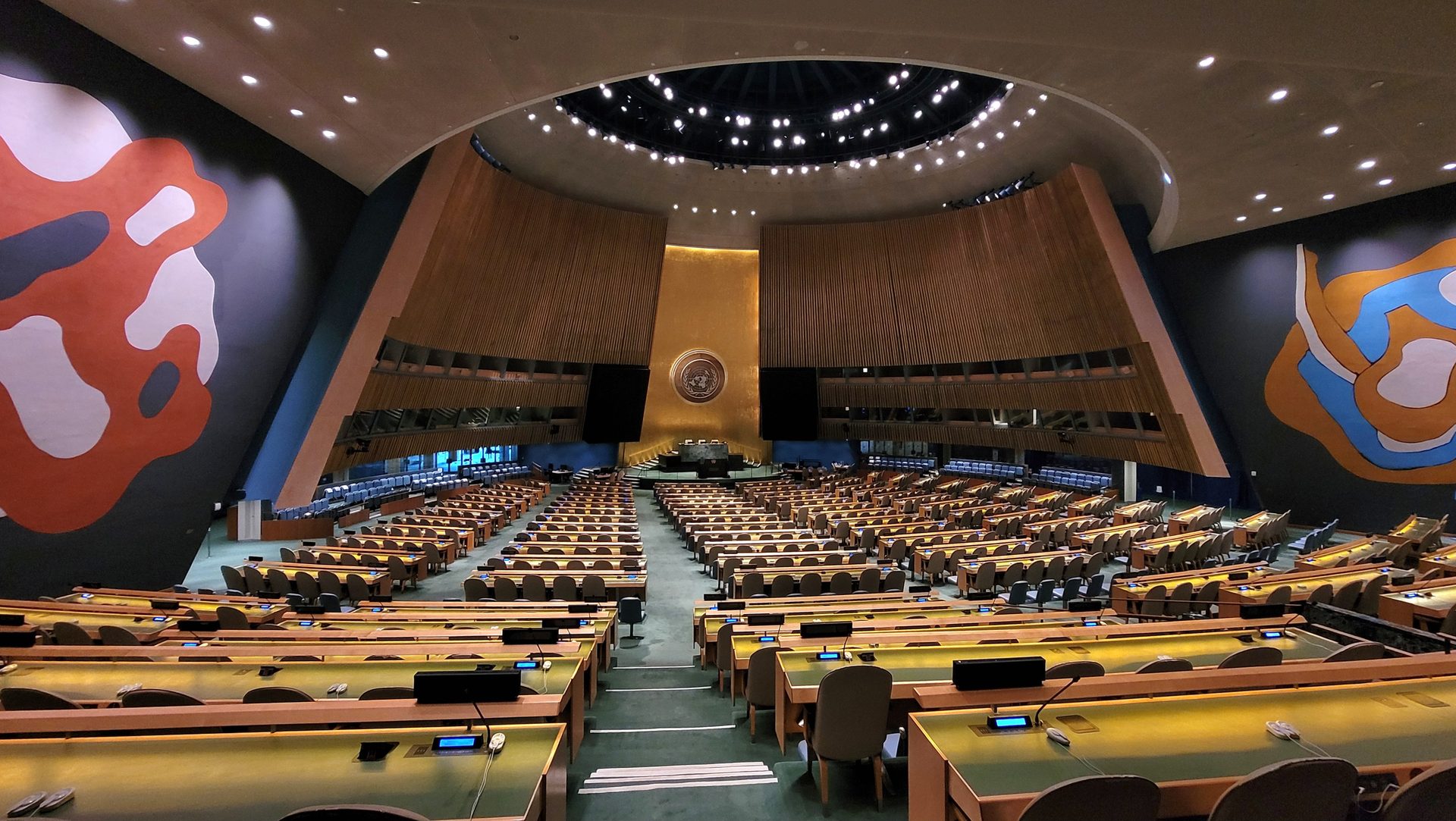
The world's most consequential election is one in which nobody gets to vote — and nobody is winning.
Three months before António Guterres's second term ends on 31 December 2026, no clear frontrunner has emerged to become the tenth Secretary-General of the United Nations. The Security Council's third straw poll, taken on 18 September and reported during the UN General Assembly's high-level week, confirmed it: a leader of the pack with no separation, and a field the vetos could still flatten.
The numbers: Costa Rica's Rebeca Grynspan led with 9 "encourage", 5 "discourage" and 1 "no opinion". Guyana's Carolyn Rodrigues-Birkett was close behind at 8 "encourage", 6 "discourage", 1 "no opinion". Behind them came Uganda's Olara Otunnu, Argentina's Rafael Mariano Grossi, Senegal's Macky Sall, and Ecuador's two entries, María Fernanda Espinosa and Ivonne A-Baki.
The ballots are anonymous, and the anonymity is the entire architecture of the race. A candidate needs at least 9 of 15 Council votes — and, crucially, no veto from any of the five permanent members: the US, the UK, France, China and Russia. Grynspan's 9 "encourage" meets the first bar. But those 5 "discourage" votes? They may be P5 ballots. They may not be. Nobody knows.
This is the beautiful, maddening logic of the selection. A straw poll is a weather vane, not a vote: it tells you where the wind is without telling you which gust can knock the house down. Every ambassador reads the same numbers and reaches a different conclusion — which is why the room keeps polling instead of deciding.
What happens next is mechanical and, in its way, elegant. Another anonymous poll is scheduled for 29 September — the fourth straw poll, two days from now. Then, likely in October under Greece's presidency of the Council, comes the colour-coded poll: ballots that distinguish the P5 from the ten elected members. That is the moment the veto math goes from speculation to arithmetic. The Council then recommends a single name to the General Assembly, which formally appoints the winner.
Chile's Michelle Bachelet has already left the board, withdrawing after weak numbers in the earlier rounds. Her exit is the poll's first casualty, and it clarified nothing: her votes scattered, her reasons stayed private.
The straw poll tells you where the wind is — without telling you which gust can knock the house down.
And the field may not be closed. Late-entry speculation — the UN's favourite parlour game — surrounds Lana Nusseibeh of the UAE, Sigrid Kaag of the Netherlands, and Kassym-Jomart Tokayev of Kazakhstan. Russia's ambassador Vassily Nebenzia, reading the deadlock, hinted that more candidates could still emerge. In UN races, a deadlocked field is not a bug — it is how compromise candidates are born.
The stakes are heavier than the ceremony suggests. The successor inherits a UN in genuine financial crisis, a map of proliferating conflicts, and — the sharpest pressure of all — a US government openly questioning the organisation's purpose. Whoever takes the 38th floor on 1 January walks into the hardest inbox in multilateralism.
There is a history-making possibility in the numbers. Five of the eight candidates are women — and in 80 years of Secretaries-General, there has never been one. A BRICS communiqué has already flagged both the historic absence of women and the under-representation of Latin America, the Caribbean, Africa and Asia in the top job. The politics of representation are not decorative here; in a race decided by consensus and veto, they are leverage.
Behind closed doors, the question diplomats are really asking is simpler than the ballots make it look: who can survive the P5? The "discourage" votes are the x-rays of this race — invisible power made faintly visible. Until the colour-coded poll names which permanent member objects to whom, the frontrunner is a frontrunner on paper only.
Western coverage — Reuters, PassBlue — reads the race as a management problem: an institution choosing a chief executive while its largest shareholder questions the institution. Reuters' six takeaways frame the unsettled field as a risk — a UN heading into 2027 without a confirmed leader, in a financial hole, is a UN the markets of diplomacy discount.
In this telling, the veto math is a governance defect: five countries hold a kill switch over the world's top diplomat, and the anonymous ballots exist precisely because nobody will say so on the record. PassBlue's straw-poll reporting treats the 29 September poll as the moment the race either clarifies or collapses into October horse-trading.
Eastern coverage reads the same ballots and sees a different institution: not a management problem but a power map. From this angle, the P5 veto is not a defect — it is the design, the price of keeping the great powers inside the tent. Nebenzia's hint about late entries is read here as strategy, not speculation: Russia keeping its options open while the field stays fluid.
The read from the East treats Grynspan's five "discourage" votes as the story's real headline — not because of who cast them, but because nobody can find out. The colour-coded poll, in this telling, is the moment the mask slips: October is when the permanent five have to show their hands.
Global South coverage — The Eastleigh Voice of Kenya, 360 Angola/Mozambique, GNA TV — reads the race as a representation story. Seven or eight candidates, five women, a BRICS communiqué demanding an end to the historic exclusion of women and of the under-represented regions: in this telling, the arithmetic of the Council is inseparable from the arithmetic of legitimacy.
The read from Nairobi and Luanda is pointed: the Secretary-General is the one global office where the Global South has a structural claim, and every straw poll that produces no winner is read as the old order buying time. Bachelet's withdrawal is reported here as a caution — name recognition is not enough; the P5 math is the only math that counts.
